

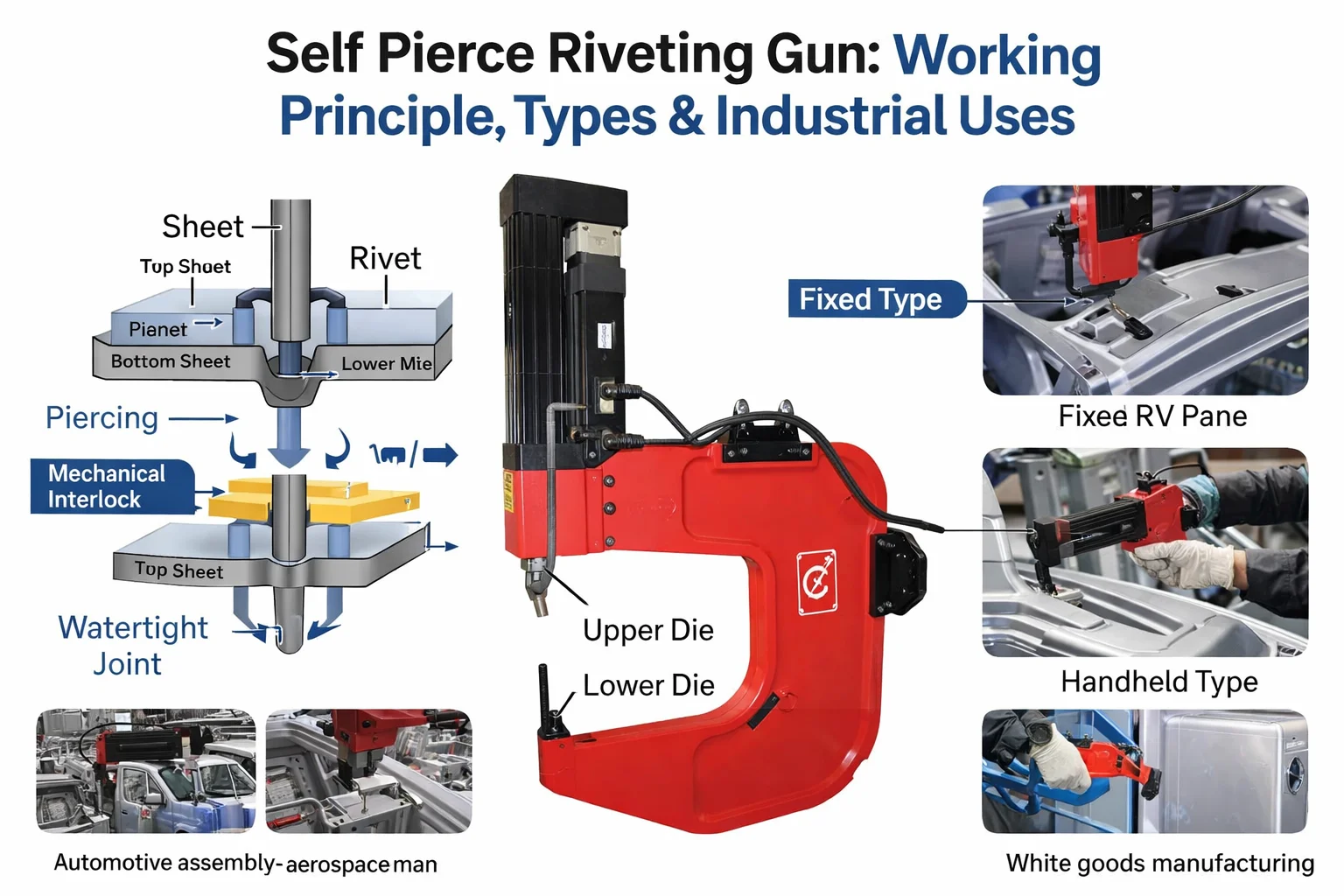
Self pierce riveting (SPR) is a high-performance cold mechanical joining process widely used in automotive, aerospace, and advanced manufacturing industries. It enables the joining of two or more material layers without the need for pre-drilled holes, making it ideal for high-speed, automated production environments.
Unlike welding, SPR does not rely on heat or fusion. Instead, it forms a mechanical interlock through controlled plastic deformation of both the rivet and workpiece materials. This makes it especially valuable for dissimilar materials such as aluminum, high-strength steel, and composite structures, where traditional welding often fails or degrades material properties.
How Self Pierce Riveting Works
The SPR process is based on a precise sequence of mechanical actions:
1. Clamping of Materials
The sheet stack (usually 2–4 layers) is tightly clamped between a die and a blank holder to ensure stability during riveting.
2. Rivet Penetration
A semi-tubular rivet is forced through the top layers of material using a controlled punch force.
3. Die-Assisted Flare Formation
Instead of piercing the bottom sheet, the rivet is guided by the die, causing it to flare outward within the lower sheet.
4. Mechanical Interlock Creation
A secure “button-shaped” interlock is formed, holding the sheets together without full penetration of the bottom layer.
This non-penetration characteristic is critical, as it helps maintain structural integrity and corrosion resistance, particularly in automotive body applications.
Key Advantages of Self Pierce Riveting
1. No Pre-Drilling Required
SPR eliminates the need for hole preparation, reducing cycle time and improving production efficiency.
2. Strong Dissimilar Material Joining
It can reliably join combinations such as:
- Aluminum to steel
- High-strength steel to aluminum
- Polymer-metal hybrid stacks
This makes it essential for lightweight vehicle design and EV manufacturing.
3. High Fatigue Strength and Structural Reliability
The mechanical interlock provides excellent resistance to vibration and cyclic loading, making it suitable for vehicle chassis, crash zones, and structural frames.
4. No Thermal Distortion
Since SPR is a cold process, it avoids:
- Heat-affected zones (HAZ)
- Metallurgical changes
- Thermal deformation
5. Automation-Friendly Process
SPR is highly compatible with:
- Robotic arms
- Automated production lines
- Inline quality monitoring systems
SPR vs Traditional Joining Methods
Manufacturing engineers often compare SPR with welding, adhesives, and mechanical fastening. The differences are significant:
- Spot welding requires clean surfaces, consistent electrical conditions, and similar materials.
- Adhesives provide strength but require long curing times.
- Bolts and screws increase weight and require assembly time.
SPR combines the best of all worlds:
- Fast like welding
- Flexible like mechanical fastening
- Clean like adhesive bonding (when used in hybrid joints)
In automotive body-in-white applications, SPR is now a mainstream joining method for aluminum and mixed-material structures.
Industrial Applications of Self Pierce Riveting
Automotive Manufacturing
SPR is most widely used in:
- Vehicle body-in-white assembly
- EV battery enclosure structures
- Door panels, roofs, and chassis components
Automotive OEMs prefer SPR due to its ability to handle lightweight multi-material architectures, which are essential for fuel efficiency and electric mobility.
Aerospace Structures
In aerospace, SPR supports:
- Lightweight fuselage panels
- Interior cabin structures
- Hybrid composite assemblies
Rail, Appliance, and General Manufacturing
Other industries use SPR for:
- Rail car panel assemblies
- Home appliance metal frames
- Industrial equipment enclosures
Engineering Challenges in SPR Process
Despite its advantages, SPR requires careful process control. Key challenges include:
Material Stack Design
Different materials require optimized:
- Rivet geometry
- Die shape
- Force application profiles
Joint Quality Control
Critical parameters include:
- Interlock strength
- Button height
- Sheet separation resistance
Tool Wear and Maintenance
High-volume production demands:
- Regular die inspection
- Rivet feed consistency
- Punch alignment accuracy
Self Pierce Riveting in Smart Manufacturing
Modern SPR systems are evolving with Industry 4.0 technologies. Advanced systems now integrate:
- Real-time force monitoring
- AI-based defect detection
- Digital twin simulation of joining processes
These improvements allow manufacturers to predict joint quality before production, reducing waste and improving efficiency.
Heron Welder: Engineering Reliable SPR Solutions
As a global manufacturer of industrial welding and joining systems, Heron Welder provides advanced SPR solutions designed for modern manufacturing challenges.
Heron’s expertise covers:
- Automated self pierce riveting systems
- Integrated welding and joining production lines
- Custom tooling for complex material stacks
- High-speed robotic riveting cells
With decades of engineering experience, Heron supports OEMs and Tier-1 suppliers in achieving:
- Higher production efficiency
- Improved joint reliability
- Lower manufacturing cost
- Scalable automation integration
For manufacturers transitioning toward lightweight multi-material production, Heron’s SPR technology delivers both precision and industrial scalability.
Best Practices for Optimized SPR Performance
To achieve high-quality riveted joints, engineers should follow:
- Proper material stack selection based on thickness and strength
- Accurate die and rivet matching for each application
- Controlled force-displacement calibration
- Regular monitoring of joint cross-sections
- Integration of inline quality inspection systems
These practices ensure consistent performance in high-volume production environments.
Frequently Asked Questions (FAQs)
1. What is self pierce riveting used for?
Self pierce riveting is used to join sheet metals and dissimilar materials without drilling holes, commonly in automotive and aerospace manufacturing.
2. Is SPR better than welding?
For multi-material and lightweight structures, SPR often performs better than welding due to its ability to avoid heat distortion and join dissimilar materials.
3. Can SPR join aluminum and steel?
Yes, SPR is widely used for aluminum-steel combinations in automotive body structures.
4. Does SPR require pre-drilled holes?
No, the process is hole-less. The rivet pierces and locks into the material stack directly.
5. What industries use self pierce riveting?
Automotive, aerospace, rail transport, appliances, and industrial manufacturing all use SPR technology.
Conclusion
Self pierce riveting has become a core enabling technology in modern lightweight manufacturing. Its ability to join complex material combinations with speed, strength, and automation compatibility makes it essential for future-ready production systems.
As industries continue to shift toward electrification and material optimization, SPR will remain a key joining solution for high-performance engineering applications.
Work with Heron for Advanced SPR Solutions
Heron Welder delivers cutting-edge self pierce riveting systems engineered for precision, durability, and automation efficiency. Whether you are developing new EV platforms or optimizing industrial production lines, Heron provides customized SPR solutions tailored to your manufacturing needs.
Contact Heron today to request a quote or consult with our engineering team for advanced self pierce riveting and automated joining solutions.

 English
 French
 Spanish
 Portuguese
 Deutsch
 Turkish
 Dutch
Dutch
 Italiano
 Russian
 Romaian
 Portuguese (Brazil)
 Greek
Greek