

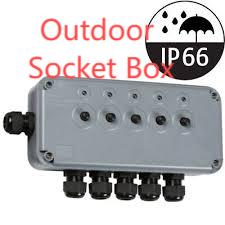
Providing safe, accessible outdoor power depends on thoughtful choices, and placing a Nante Outdoor Socket Box at the right point of use reduces cable clutter and exposure risks, while choosing a Nante Outdoor Socket Box with the correct materials and sealing prevents corrosion and water ingress. Early coordination between design, installation, and maintenance teams ensures the chosen unit matches environmental stresses and service expectations.
Real-world site assessment
Start with a realistic appraisal of the installation site. Note prevailing winds, splash zones, likely pathways of runoff, and areas where pressure washing or hose-down cleaning will occur. Examine pedestrian and vehicle traffic patterns to estimate impact risk and vandalism potential. Record temperature extremes and diurnal swings that drive condensation cycles. Translating these observations into target ingress protection (IP) or NEMA classifications and impact (IK) ratings sets the foundation for choosing an enclosure that performs in practice—not only on paper.
Materials, coatings, and corrosion control
Material selection determines lifespan. For coastal or chemical-exposed sites, favor stainless grades or specialized alloy options and ensure fasteners, gland plates, and internal rails use compatible metals to avoid galvanic corrosion. Powder-coated steel with a verified coating system is cost-effective for many industrial yards, while fiberglass-reinforced plastics offer dielectric isolation and excellent chemical resistance. Insist on manufacturer test data for salt-spray and adhesion when coatings are specified; proper paint thickness and surface preparation matter more than the nominal coating type.
Sealing details and ingress protection
Seams, doors, and cable entries are where ingress protection succeeds or fails. Continuous gaskets with proven compression characteristics are essential; avoid segmented seals that can leak when covers flex. Use captive fasteners to prevent lost hardware and ensure consistent closure torque. Select cable glands sized to the outer jacket and install strain reliefs so vibration doesn’t assault terminals. If meters or indicators are required, choose lockable windows with UV-stable glazing to avoid frequent opening and seal degradation. For washdown environments, IP66 or IP69K rated solutions are appropriate.
Electrical layout, thermal planning, and condensation prevention
Think beyond the box to what it contains. High-current breakers, contactors, and surge arrestors generate heat; place these components to promote natural convection and leave service space for cooling. Use reflective finishes and sunshades to reduce solar gain where sunlight is direct. For locations with night–day temperature swings, incorporate filtered breather vents, desiccant carriers, or thermostatically controlled low-wattage heaters to control condensation. Condensation control prevents corrosion and insulation breakdown that later manifest as failures.
Mounting, ergonomics, and user safety
Mounting height and location affect safety and convenience. Place sockets at ergonomically appropriate heights for routine use and maintenance, but avoid positions where vehicles, snowplows, or high-traffic equipment can strike them. Recessed mounting or protective shrouds reduce accidental impact. In public or unsupervised areas, opt for lockable covers, tamper-resistant fasteners, and clear labeling to discourage misuse. Provide local isolation switches where maintenance will occur and ensure protective devices are coordinated to avoid nuisance trips.
Accessories, modularity, and future-proofing
Choose systems that support accessories and modular upgrades: removable gland plates, spare DIN-rail space, and swappable socket modules simplify changes without replacing the whole enclosure. Integrated options—surge protection, meters, and communication modules—are useful when planned early. Standardizing accessory footprints across multiple units reduces spare-part types and shortens repair time when components fail in the field.
Installation best practices
Correct installation preserves the enclosure’s intended performance. Use appropriate sealing compounds only where recommended, maintain recommended bending radii for conductors, and secure grounds with proper torque. Document terminal torque values at commissioning and include them in asset records for future inspections. Favor factory-configured harnesses when available to minimize field wiring errors and maintain warranty coverage. Ensure drainage paths behind mounted units to avoid water pooling against the enclosure back.
Maintenance planning and lifecycle considerations
A modest preventive-maintenance program prevents most field failures. Inspect gaskets, hinges, and latches regularly and replace compressed seals proactively. Check for loose fasteners and signs of coating failure or corrosion; perform thermal scans under load to catch high-resistance connections early. Keep a spare kit of common consumables—gaskets, captive screws, socket inserts—to shorten repair times. Track service history to refine inspection intervals and validate material performance against real operating conditions.
Selecting and procuring wisely
When procuring, require datasheets showing IP/IK ratings, material certificates, and third-party test evidence. Ask for CAD models to verify mounting and service clearances. Compare warranty terms, spare-part availability, and factory-configured options. Evaluate total cost of ownership rather than lowest purchase price—enclosures that are easier to service, resist corrosion, and offer modular upgrades typically cost less over their operational life. For detailed specifications, model comparisons, and accessory options, visit https://www.nante.com/product/

 English
 Arabic
 French
 Spanish
 Portuguese
 Turkish
 Dutch
Dutch
 Italiano
 Russian
 Romaian
 Portuguese (Brazil)
 Greek
Greek