

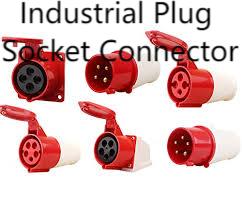
Specifying the right connection early can prevent costly outages and simplify maintenance later: choosing a Industrial Plug Socket Connector at the design stage aligns mechanical retention, grounding, and sealing expectations, while selecting a mismatched part risks overheating and service interruptions. For many installations, a considered choice of a Industrial Plug Socket Connector reduces lifecycle costs and improves safety by ensuring compatibility with enclosures, cables, and environmental demands.
Matching Electrical Ratings To Application Demands
Begin by defining the real-world electrical envelope: continuous current, voltage, and short-term inrush from motors or soft-start equipment. Don’t rely solely on nominal ratings — account for ambient temperature derating, harmonic content from variable-speed drives, and any expected overload scenarios. Overspecifying moderately reduces contact heating and extends service life, while underspecifying increases the risk of contact deterioration and thermal faults.
Environmental Sealing and Mechanical Retention
Ingress protection is a primary consideration for outdoor, washdown, or chemically exposed sites. Choose housings and gaskets with proven IP/NEMA performance and materials resistant to oils, solvents, and sunlight. Mechanical locking systems — threaded collars, bayonet couplers, or positive latches — guard against accidental disconnections in high-vibration environments. Proper strain relief and cable anchoring eliminate lever forces that otherwise stress contacts and lead to fretting.
Contact Materials, Plating, and Thermal Performance
Contact metallurgy determines conductivity and wear behaviour. Copper alloys with nickel or silver plating offer an effective balance between conductivity, corrosion resistance, and durability. For control pins, low-voltage signal contacts sometimes benefit from gold plating to preserve low resistance. Also evaluate contact cross-section: larger contact areas reduce resistive heating. Ensure insulating components are rated for the expected temperature cycles and chemical exposures of the site.
Nante Socket Options For Field Use
When project logistics matter, product families that offer modular inserts, standardized spare parts, and clear documentation ease procurement and maintenance. Look for connector series that provide installation torque values, replacement seal kits, and mounting accessories so technicians can perform safe, quick repairs. Standardizing on a single, well-supported family across a fleet reduces spare-part complexity and minimizes downtime when replacements are required.
Installation Practices That Prevent Failures
Correct preparation and assembly of conductors are as important as component selection. Follow specified crimping procedures or manufacturer lug instructions, use the recommended torque for screw-terminals, and verify earthing continuity. For portable or temporary setups, add visible labels and color-coding to prevent mismating. Employ proper cable anchoring and routing to avoid bending stresses at the termination point.
Commissioning, Testing, and Routine Inspection
Initial commissioning checks should include continuity, insulation resistance, and contact-resistance measurements where feasible. Record baseline contact resistance to track degradation over time. Establish periodic inspection intervals based on site severity: inspect seals and gaskets, check for contact discoloration (a heating symptom), and verify locking mechanisms. Simple on-site testers for contact resistance can catch problems before they become safety hazards.
Spares, Training, and Practical Logistics
Maintain a compact spare kit containing common gaskets, inserts, and replacement contacts to handle most field repairs without long procurement delays. Train technicians in safe disconnection procedures, correct torque values, and the hazards of improvised adaptors. For rental or temporary power operations, use labeled, color-coded systems and limit connector families to those that are readily interchangeable among vendors.
Lifecycle Cost Considerations
Total cost of ownership includes purchase price, installation labour, expected replacement intervals, and the cost of outages. Investing in durable materials and serviceable designs often reduces repair frequency and lowers lifecycle costs. When evaluating options, weigh ease of servicing and availability of documented replacement parts as heavily as the initial price.
Implementing good specification discipline — defining ratings, environmental needs, and maintenance plans upfront — delivers more reliable, safer power distribution. Thoughtful selection, disciplined installation, and proactive inspection will keep systems running and technicians safe. For more detailed guidance and a technical overview of connector types and uses, visit https://www.nante.com/news/industry-news/what-is-industrial-plug.html

 English
 French
 Spanish
 Portuguese
 Deutsch
 Turkish
 Dutch
Dutch
 Italiano
 Russian
 Romaian
 Portuguese (Brazil)
 Greek
Greek