

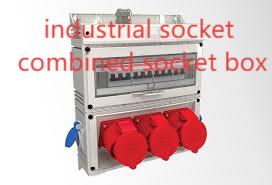
Choosing the right enclosure at project start matters: a well-specified industrial socket box protects circuits, simplifies wiring, and reduces future retrofit costs. Early coordination around location, mounting, and service clearances makes installations safer and cuts labor — a principle facilities teams and contractors both value when planning high-use power points in workshops, plants, or outdoor work areas.
Materials, Impact Resistance, and Corrosion Protection
The enclosure’s material set the baseline for longevity. Die-cast aluminum and stainless steel provide robust impact resistance and a reliable grounding path for industrial installations; engineered thermoplastics offer lightweight, corrosion-resistant alternatives where metal isn’t ideal. Choose UV-stable finishes and corrosion-grade fasteners for outdoor or coastal sites. Face design matters too: recessed receptacles and protective bezels reduce accidental knocks, while thicker wall sections and internal ribs prevent deformation when subjected to mechanical abuse.
Mounting, Placement, and Nante Installation Kits
Correct mounting reduces strain on conductors and prevents seal failure. Surface-mounted boxes should be anchored to flat, reinforced panels or backboards using torque-specified fasteners to minimize flex. Pole and pedestal kits adapt sockets for remote lighting or temporary power. Using manufacturer-specified installation kits preserves IP/IK ratings and simplifies spare-part management. When planning placement, prioritize ergonomic heights and cord routing that avoid trip hazards and reduce bending stress on plugs.
Wiring Practices, Load Planning, and Protective Coordination
Reliable operation begins with correct wiring. Size conductors for continuous loads plus motor inrush where applicable, and coordinate upstream breakers or fuses to provide selective protection. Use appropriately sized glands and strain reliefs at entry points to prevent conductor movement and terminal loosening. Maintain clear separation between power and control wiring to simplify troubleshooting, and include labeled terminal blocks or silk-screened wiring diagrams inside the box to speed future service.
Safety Features, Standards, and Field Usability
Specify products with the necessary third-party listings and declared IP and IK ratings for the intended environment. Lockable covers, tamper-resistant options, and gasketed in-use lids enhance safety in public or harsh areas. Consider ground-fault protection for outlets used near water and include clear lockout/tagout access for maintenance. For field usability, captive fasteners, removable front plates, and clearly marked connection points reduce human error and shorten service time.
Maintenance Strategy, Diagnostics, And Lifecycle Value
Design for maintainability to reduce total cost of ownership. Tool-free removable panels, modular terminal carriers, and replaceable gaskets allow quick in-field repairs without full unit replacement. Implement a preventive schedule: seasonal gasket checks, annual torque verification on connections, and thermal imaging during planned outages to detect hot spots before failure. Keep a compact spare-parts kit (gaskets, dust caps, fuses) on site to shorten mean time to repair and minimize operational disruption.
Retrofit Considerations And Practical On-Site Tips
Surface-mounted socket boxes are ideal for retrofit work because they avoid wall demolition and often reuse existing conduit, but always verify the condition of grounding and bonding before connecting a new enclosure. Dry-fit assemblies on the bench, pre-label harnesses, and confirm accessory compatibility before final installation to avoid rework. Apply approved corrosion inhibitors on exposed threads in coastal sites and ensure gasket compression is uniform during final torque to maintain protection.
Environmental Selection And Special Use Cases
For washdown or food-processing areas, specify fully sealed units with stainless hardware and rounded edges for hygiene. In chemical or abrasive environments, select specially coated metals or engineered polymers that resist degradation. For mobile or vibration-prone installations, add flexible conduit and shock-damping mounts to protect terminals from cyclic stress.
Conclusion: Specify Thoughtfully, Maintain Regularly
When planners prioritize environmental fit, proper mounting, accessible wiring, and a sensible maintenance plan, an industrial socket box becomes a long-lived asset rather than a recurring liability. Prioritizing rated materials, field-friendly accessories, and preventive checks reduces downtime and lifecycle cost for industrial facilities. For specifications, accessory options, and detailed installation guidance, visit www.nante.com

 English
 Arabic
 French
 Spanish
 Portuguese
 Deutsch
 Turkish
 Dutch
Dutch
 Italiano
 Russian
 Romaian
 Greek
Greek