

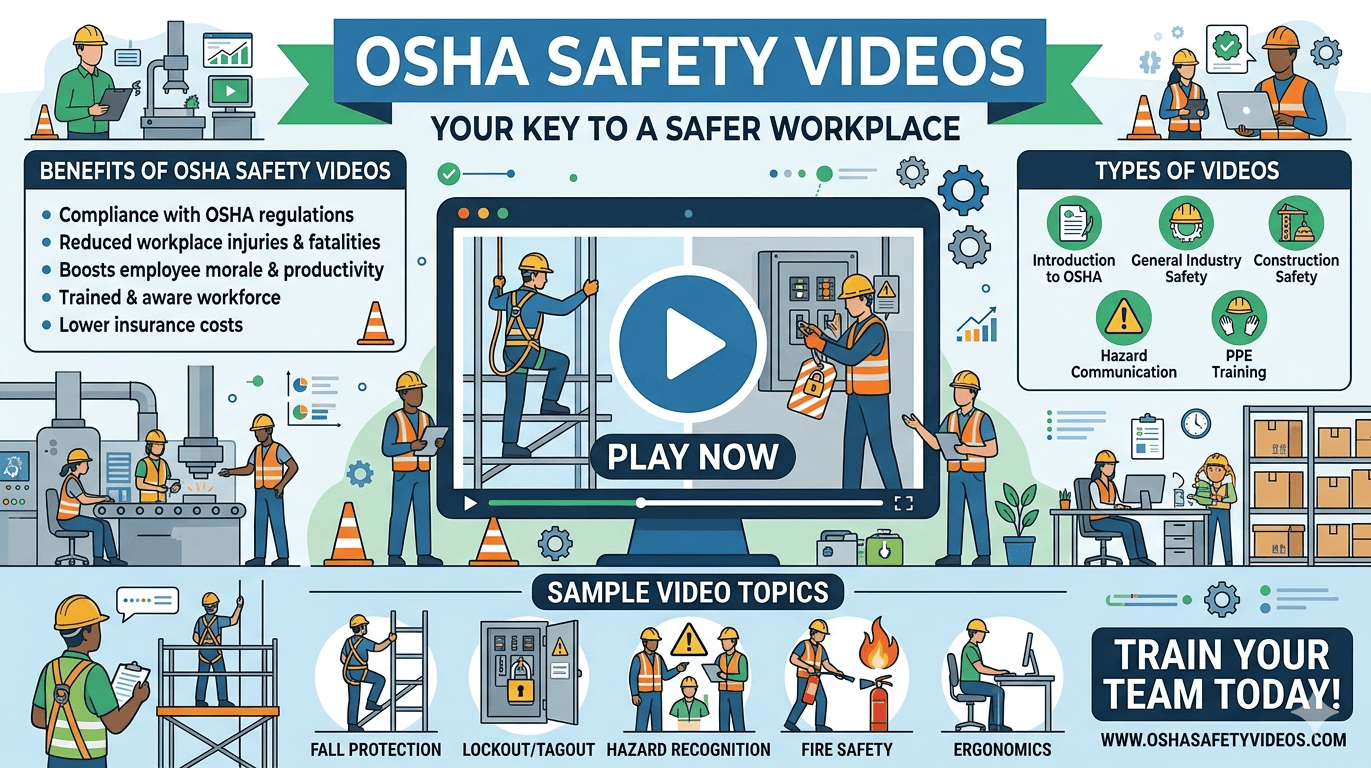
OSHA Safety Videos have become one of the most effective tools for improving employee awareness and reducing workplace accidents across industries in the United States. Businesses in construction, manufacturing, warehousing, healthcare, and logistics rely on visual learning methods because workers often retain information better through real-life demonstrations rather than lengthy manuals.
Companies that ignore proper workplace education usually face higher injury rates, lost productivity, workers’ compensation claims, and OSHA penalties. A poorly trained workforce creates unnecessary risks that damage both employee well-being and company reputation. This is why modern organizations are investing heavily in video-based learning systems that simplify complex safety procedures.
The Role of Visual Learning in Accident Prevention
Many workplace accidents happen because employees either misunderstand procedures or fail to recognize hazards quickly enough. Traditional training methods often overwhelm workers with technical information that is forgotten within days. Video-based instruction changes that by showing actual scenarios, equipment usage, and hazard responses in a practical format.
Well-produced Safety Videos help workers understand:
- Proper equipment handling
- Emergency response procedures
- Hazard identification
- Personal protective equipment usage
- Safe lifting techniques
- Lockout/tagout procedures
- Fire prevention practices
Visual demonstrations reduce confusion and improve consistency among teams. Workers can clearly see both correct and incorrect behaviors, making lessons more memorable and actionable.
Best Types of OSHA Safety Videos for Workplace Safety
Hazard Communication Videos
Chemical exposure remains a major issue in many American workplaces. Hazard communication videos teach employees how to read labels, understand Safety Data Sheets (SDS), and safely store hazardous materials. These videos are especially important for factories, laboratories, and maintenance departments.
Employees who lack chemical awareness can accidentally create dangerous reactions, inhale toxic substances, or misuse protective equipment. Strong hazard communication training significantly lowers these risks.
Fall Protection Training Videos
Falls are one of the leading causes of workplace fatalities in the United States, particularly in construction and industrial environments. Fall protection videos teach workers how to properly use harnesses, ladders, guardrails, and anchor systems.
These videos should include realistic job site examples because generic instruction often fails to connect with workers operating in high-risk environments. Companies that cut corners on fall protection training usually experience preventable injuries and legal consequences.
Forklift Safety Videos
Forklift accidents frequently result in severe injuries, damaged inventory, and costly downtime. Quality forklift training videos focus on load balancing, blind spots, inspection procedures, and pedestrian awareness.
Warehouses with heavy traffic benefit greatly from repeated forklift education because operators can become overconfident or careless over time. Refresher video sessions help reinforce safe operating habits before bad behavior becomes normalized.
How Safety Training Improves Workplace Culture
Strong Safety Training does more than reduce injuries. It creates accountability throughout the organization. Employees become more aware of their surroundings, supervisors enforce procedures more consistently, and management demonstrates commitment to worker protection.
A weak safety culture usually reveals itself quickly. Workers ignore PPE rules, shortcuts become common, and hazards remain unreported. Eventually, accidents happen because unsafe behavior becomes accepted as normal.
Companies with strong safety systems often experience:
- Lower employee turnover
- Reduced insurance costs
- Higher productivity
- Better OSHA compliance
- Improved employee morale
Training should never be treated as a one-time event. Repetition and reinforcement are critical if businesses want long-term behavioral improvement.
Why Interactive Training Outperforms Paper Manuals
Most employees do not fully absorb information from lengthy printed manuals. Workers often skim documents simply to complete compliance requirements. Video instruction creates higher engagement because it combines audio, visuals, demonstrations, and real-world examples.
Interactive learning also benefits multilingual workplaces where language barriers may exist. Visual instruction reduces misunderstandings that written documentation alone cannot solve.
A proper Safety Orientation Course should include video-based modules during onboarding so new hires understand company procedures before entering active work zones. Throwing inexperienced workers directly into hazardous environments without structured orientation is reckless and financially irresponsible.
Industries That Benefit Most from OSHA Video Training
Some industries face substantially higher workplace risks than others. OSHA-focused video training is especially valuable in:
Construction
Construction sites constantly change, creating new hazards daily. Workers need continuous updates on fall risks, electrical dangers, scaffolding, and heavy equipment operation.
Manufacturing
Factories involve moving machinery, repetitive motion tasks, heat exposure, and chemical handling. Video demonstrations help reduce confusion around machine guarding and emergency shutdown procedures.
Warehousing and Logistics
Warehouses face frequent incidents involving forklifts, lifting injuries, and falling inventory. Consistent safety education helps reduce preventable accidents.
Healthcare
Healthcare employees encounter bloodborne pathogens, patient handling injuries, and infection risks. Proper instructional videos improve compliance with sanitation and PPE procedures.
What Makes an Effective OSHA Safety Video
Not all training videos are useful. Many companies waste money on outdated or generic content that employees ignore. Effective OSHA Safety Videos should include:
- Realistic workplace scenarios
- Clear step-by-step demonstrations
- Industry-specific hazards
- Updated OSHA compliance standards
- Short and focused lessons
- Multilingual accessibility
- Engaging visual presentation
Long, boring videos filled with corporate jargon usually fail because employees mentally check out within minutes. Good training content is direct, practical, and easy to understand.
Final Thoughts
Reducing workplace accidents requires more than policies sitting in a binder. Employees need practical, engaging, and repeatable instruction that prepares them for real hazards. OSHA Safety Videos help businesses create safer environments by improving awareness, reinforcing procedures, and reducing human error.

 English
 French
 Spanish
 Portuguese
 Deutsch
 Turkish
 Dutch
Dutch
 Italiano
 Russian
 Romaian
 Portuguese (Brazil)
 Greek
Greek